
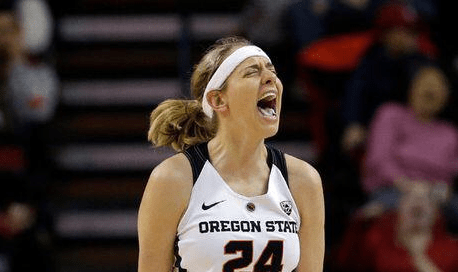
Back in my college days, I became friends with Sydney Wiese, the star of the Oregon State University women’s basketball team. We did group projects together and sat in the back of class watching games on her phone, but didn’t necessarily have a lot of deep conversations.
Sydney went on to play professional basketball, both overseas and in the WNBA for seven years. Then, this past summer, I heard the news that she was coming back to Corvallis to work as an assistant coach.
I was in Oregon for the summer, and one Sunday I went to church at Grace City in Corvallis. As I was entering the row to get to my seat I realized there she was, right next to me.
We exchanged numbers, got coffee, and I was so enchanted by her stories and testimony that I asked her if I could interview her for my blog.
Well. I’d never verbally interviewed someone for my blog before. She came over for Sunday dinner and we had a fascinating three-hour conversation where I asked every single question I was curious about. But then, the transcribing and editing process completely daunted me, and I didn’t finish until this week.
Nevertheless, I hope you’ll find Sydney’s story as interesting as I did.

Photo: Sydney, me, and our friend Dakota on graduation day
Emily: So we met at OSU and had classes together, and the three things that I remember about you that stood out were:
- You had a deep love of basketball and your coach and your teammates
- You were a woman of faith and very open about loving Jesus…
- And you were also in love with Justin Bieber.
Sydney: (laughs) All three are still true!
Emily: So my first question is, as a girl from Phoenix, Arizona, how did you end up as the star basketball player at Oregon State University?
Sydney: Well, I think it first starts with Justin Bieber.
(laughter)
Actually, it’s crazy how all those three are interwoven. The recruiting process—coaches will come to watch you play basketball games, and then they’ll start to have phone calls to get to know [you], and I just remember my first phone call with my head coach at Oregon State. It was about Justin Bieber.
I loved it because a lot of my other calls [were] about basketball things [and] school things that were just so, like, boring. And so then when we were talking about Justin Bieber, I was like, this place seems different. I’m interested. I’m intrigued by this.
Once I had my first conversation with my head coach Scott Rueck, I started comparing my conversations with him to my other schools that I was talking to.
Emily: Was the difference that you felt like Scott Rueck saw you as an individual person more?
Sydney: Yeah, I felt like a human—like a kid instead of a prospective student-athlete. Not that the other schools didn’t value me—I just felt more of a genuine connection, and it was fun talking to him.
Then I went on a visit after the summer to Oregon State and I met my future teammates. Corvallis just felt like home right away. So it all started with J. Biebs, but it’s rooted in Christ. I knew that this is exactly where I wanted to spend my four years.
One of the things that was always told to me when I was trying to make a decision for where to go to school was, Where would you like to live and enjoy going to school if you didn’t have basketball? Like if you ever got hurt? And I knew I loved Corvallis. I loved my teammates. I didn’t need to be playing basketball to enjoy living here.
And I’m still here. So clearly, I still love it.
Also, the staff is a faith-based staff. I knew that coach Rueck was a man of faith. Not only does he claim to be Christian, but he walks it. Our conversations felt deeper than surface-level questions. I felt like it was rooted in faith.
Yeah, so that also drew me to wanting to play for him and to be part of everything at Oregon State. [But] J Beebs doesn’t hurt as well. (Laughs)
Emily: What was your faith journey like during that Oregon State era?
Sydney: How much time do you have? I’m so grateful. At Oregon State, it’s not that we just focus on recruiting Christians—everybody comes from their own walks of life. But one of my first weekends, I met Ruth Hamblin, and she invited me to church at Grace City. I remember walking in there and it felt like home. I was being introduced to a deeper dimension of my faith walk that I was so excited about.
I love that you asked this question because it’s bringing back a memory. I think it was towards the end of summer school before freshman year started. We’d just had a student-athlete meeting—like all student-athletes [from] all the sports. And I felt so overwhelmed by everything—it was becoming real.
I decided to go for a run after the meeting. It was sort of rainy, becoming like fall in Corvallis. I was praying while I was running and so anxious and nervous about everything. I remember, towards the end of the run, crying and dropping to my knees. It felt so big to me that I just…I couldn’t do it by myself. There was no way.
[As] I fell to my knees, the sun came out. I felt so seen, and the peace that transcends understanding came over me. My theme going into my career was “God is good all the time,” and it started there because I just felt like wow, like another dimension of God is real. He’s taking care of the details.
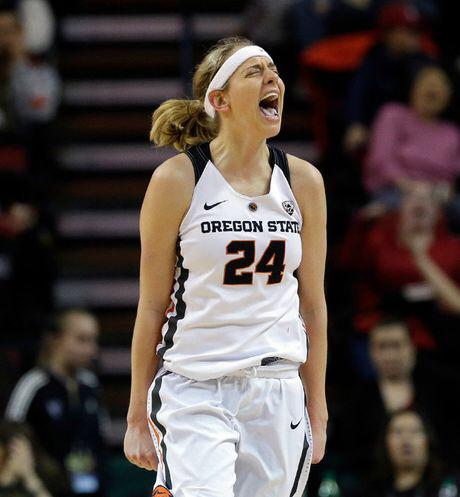
Emily: (After taking a moment to pause in awe over that great story.) Did you always dream of playing in the WNBA? At what point did you realize this was going to be a reality for you?
Sydney: Yes, similar to that God moment at the track at Oregon State—I was in Minnesota on vacation when I was like in eighth grade. We were in the grocery store. I was one of those kids that always had a ball with me. It might not have been a full-size basketball, but I had a little ball dribbling through the grocery store. Just laying a ball up over, like, the sign “frozen pizzas.” That was me. God bless my parents.
And I just remember being in that grocery store and a vision came to my mind of playing high school basketball, getting a division one college scholarship, and then playing professionally. And I was like, okay. Those are my main goals. I didn’t know how it was gonna come to life, but that’s what I knew was set out for me.
And then it became real my senior year of college. I think I always believed in it and wanted it, but once my senior year of college was happening, I was like, oh my gosh, I actually might be able to do this.
(When Sydney said this, I thought it was really funny that she didn’t know she was WNBA worthy until her senior year. We met junior year, and even I, a person who didn’t really follow sports, was aware that she was so good she’d probably end up in the WNBA. Then later, as I edited this interview, I decided to go dig up the Facebook post I wrote when I first met Sydney. Here it is:)

Sydney: (After I expressed my dismay that she didn’t realize she was WNBA material until senior year.) Yeah, I’m a pretty one-track mind person. I was so immersed in what we were doing in college, and it required everything. Towards the end of that season, once I could actually see the end, I was like, oh, the WNBA would be next.
I that’s I think why it took me so long, cause I was just so focused on what was in front of me. It’s so funny how the people around us almost see our potential way before we do.
Emily: Can you walk me through how that was for you, getting drafted to the LA Sparks, and then that first summer season with them?
Sydney: Being drafted—you hear athletes talk about it all the time and I’m just gonna be another one of those athletes that’s like, I can’t put words to it. But it really was this overwhelming feeling of indescribable emotions, because not only did I get drafted. I was invited to the draft.
Emily: Um…I don’t know much about sports…what’s the difference between getting invited to the draft? Like what does that mean?
Sydney: So like, 12 athletes from college sports were invited to New York to be part of draft night. Leading up to the draft, you got to meet people from the WNBA business offices, our union, [and] some players that can help with questions and getting used to the next journey.
Emily: So does that mean if you’re picked for that, you’re one of the top athletes? Is that what it means?
Sydney: There’s a couple things that go into deciding that. Definitely, the probability of you being chosen is high. What you did for this last college season gained a lot of notoriety throughout the nation that they want to honor. And so when I got the call that I was being invited I was like—it was my dream to be drafted. But [to] actually go to New York! My first thought was, I don’t have anything to wear! And we’re gonna be on national TV! Help, people, help!
But being drafted like that—the moment your name gets called, you just feel like everything that led to that moment was worth it.
And then the reality comes of like, I’m in it. The work’s just starting.
That first year in LA, [the LA Sparks] had won the championship the season before and I was surrounded by legends. It was so overwhelming, but amazing. The little kid in me was like. I watched them play growing up, and now I’m on the same team as them.
Going from a college level to that professional level is a tough transition for anybody. Being on a team that [had] an established rotation—like, the starters were the starters and then people were coming off the bench—that was basically set—so I had an opportunity to learn from watching on the sidelines, practicing, and just finding my routine as a professional to make sure that when my name does get called and it’s time for me to perform like I know what’s going on.
It was a very uncomfortable position for me to be in because, my whole career up until that point, I’ve played basically every game, all the minutes. And [I’m] very fortunate to have done that, but this was a different dimension of mental preparation. That was hard, but I learned so much my first year, and my teammates were amazing. They were so helpful.
Emily: I remember you telling me that WNBA players supplement their income by playing in other countries in the offseason. I believe the first year, you played in Australia, and then Israel, and then Spain, all while you were still playing for the Sparks, right?
Sydney: Yeah.
Emily: This was confusing to me, so I was trying to research it. What I understand is that…oh! It’s a stink bug! But it shouldn’t harm you, thank goodness. Are you scared of bugs? (I was conducting this interview outside on the porch.)
Sydney: I mean, I think I like observing them from a safe distance.
Emily: (Thwack!)
Sydney: That was aggressive. You were ready for that. Wow.
Emily: So am I correct in my understanding that countries like Australia and Israel and Spain have their own league—it’s basically like the WNBA but in Spain?
Sydney: Mm-hmm
Emily: And then one of those teams will hire you for a season, and it’s just a different time of year than the US season?
Sydney: Yeah
Emily: I don’t understand how that works. Isn’t there a language barrier? You don’t speak Spanish, do you?
Sydney: No. I don’t speak Hebrew…I do speak Australian (laughs). Yeah, I’m so grateful that I had the opportunity to play in so many different countries. Some people will end up on a team and that will be who they’re with for their whole overseas career. Each person’s journey is different. Some people might not play overseas—they might stay home and do commentating or have a job completely separate from the W. Or just like train and chill and be with family in the offseason and then when the summer comes around play again.
But for me I was led to five, six different countries, which I loved. I have an agent and so my agent would be the one that would present different teams to me. Sometimes I would talk to a coach. Sometimes I would talk to the general manager. Oftentimes it would just be like my agent telling me what the situation was and a lot of prayer. It’s always a leap of faith to go overseas.
Language barrier depends on the country, but usually there’s at least two or three people on the team and then one or two on the staff that speaks pretty decent if not really good English. And then everybody else, like, they speak their native tongue.
Emily: So if the head coach is telling instructions is someone just translating for you?
Sydney: Yep! The only time that I really had to experience that was my last year in Turkey. Because the head coach did not speak English. We had one of my teammates translate, or a translator on the staff that would [go to] pregame meetings. [The head coach would] be speaking and then my teammate would be right next to the ones that didn’t understand Turkish to tell us what he was saying.
And I really appreciated her because she would pick and choose what she would say. Because there would be some things, like if he was yelling at us or being disrespectful to us, she wouldn’t say that to us.
Emily: So is women’s basketball, like…are the Spanish players coming to the US for a year to play, too? Is everyone just swapping?
Sydney: The W is considered the best women’s basketball league in the world. There’s 12 teams, each team has 12 spots, and based on money and salary, sometimes teams can only afford 11 players. So [the] max that can be in the WNBA is 144 players, which makes it super competitive and difficult to be in.
Overseas you can have teams basically buy championships because they have more money. There’s a team in Turkey who has so much money that they can all but guarantee that they’re gonna compete for the championship in Turkey.
If you’re in the WNBA, teams pay attention to that. You could get more opportunities based on being in the WNBA to end up on those higher-level teams in Europe, if that makes sense.
Emily: So does that at all… how do I put this into words?
Sydney: A hundred percent. I already know what you’re asking. Yes, it does.
Emily: Knowing that you were just on a great team because they happened to be rich and they bought a great team—does that dull the feeling of success and accomplishment?
Sydney: I haven’t been on that top team in Turkey, but I have friends who have been on that team. And I think it’s still meaningful when you win. It’s a lot of work that goes into winning a championship, no matter what. But when you look at [their] roster compared to a roster that doesn’t have as much money, then it sort of just makes you feel like, well, yeah, [they] should have won.
But it’s similar in a way to college where on paper, you could have a really good roster, but it’s still about how you put it together and go about your business to have success every day.
That’s one thing that I’ve struggled with professional sports, honestly, since I’ve stepped into it. I want to approach it still like I’m a kid playing a game, but there’s the reality that comes with business, salary, money stuff, and that impacts the W and it impacts overseas. But that’s professional sports. It’s a business. When you’re a kid dreaming about it, you’re [not] like, “Oh, I can’t wait to deal with salary cap.”
Ignorant Emily: Wait, what is salary cap? I don’t know about this.
Sydney: So, WNBA, most professional sports in the States have salary cap where a team is given so much money to distribute to your players.
Emily: Oh, okay. So it’s an attempt to make it a level playing field.
Sydney: Which makes the whole thing more exciting.
Emily: More fair.
Sydney: Yes, a little bit more fair compared to overseas that does not have a salary cap. But overseas they do have loophole[s] that [are] interesting. Like, in Turkey, you can only have two foreigners. Americans and, like, an Australian would be considered foreigners. But you could have unlimited European players.
Sometimes people will get passports, so they might not be American anymore, they’re now Croatian. Then teams can maneuver and get really high-level players who have two passports.
Emily: Wait, how do you randomly get a Croatian passport?
Sydney: There’s always a way. It’s crazy.
Emily: Like, people actually go and become a Croatian citizen?
Sydney: I almost went and got a German passport because I do have a German lineage. That would be an advantage for me because then I could set my American citizenship to the side and be German.
Emily: So, the people in Germany that are deciding if people are eligible for citizenship, are they just fast-tracking sports players?
Sydney: Yeah
Emily: I had no idea.
Sydney: It’s nuts. And it’s not always simple and easy, but there are ways, where you can become nationalized in certain countries because you’re an athlete. It’s wild.
Emily: Okay, so we’re back with L.A. Sparks now. Were you only in L.A. for the season? How was your life spent in the off-season?
Sydney: I would be in L.A. from, like, end of April until end of September or October. And that would be our season. And then I usually would have, like, maybe a week, max two weeks before I would go overseas. So I’d be home in Phoenix for a little bit, make my rounds, get ready for the next season, and then I’d go overseas and be there.
Depending on how our team would do—like if we went into the playoffs—that would determine how much time I would have before I would go back to L.A. So sometimes I would be home for three weeks. Sometimes it’d be two months. It just depended.
So bless my parents, truly, for just, like, oh, Sid’s coming home for three days this time. Oh, it’s three months this time.
Emily: Were you just chilling? Or training?
Sydney: I’d be training all the time. It was never really time off.

Emily: So this era that we’ve kind of been covering—those three years you were with Sparks in the summer and then overseas in the winter—what was your faith journey like in that era?
Sydney: One of my first days of training camp, I woke up so freaking anxious. I’ve dreamt about this since I was a kid, and now it’s here, and I didn’t dream past that moment.
I just said, like, God, if you’re not in this, I don’t want it. I need you to be in the center of it because it feels too big to me right now.
I was guilty of putting professional sports on this pedestal because that was my dream my whole life, and now I was here. I didn’t want to totally identify with it, but I also wanted to recognize the privilege to do this.
When I got to my second year with the Sparks, so my second professional season, that was the hardest because it was the first time in my life where I felt like I was giving everything on the court, off the court, more time, getting there early, staying there late, and it was not paying off, and that was really hard to, like, not get rewarded.
Emily: When you say it was not paying off, do you mean you weren’t improving your game or it wasn’t being recognized by your coach?
Sydney: It wasn’t being recognized. I wasn’t getting playing time, and I would like to think that I’m not someone who cares about playing time, but there’s an expectation of I’m working really hard to at least get a chance. Maybe I suck. Maybe I’m just not cut out for professional sports.
It really messed with my mind, but I think that season also taught me, all right, I’m going to be such a good teammate. Like, we’re going to come up with cheers at the end of the bench. We’re going to celebrate and ones, three-pointers, amazing plays…
It helped me learn it’s not about me. I’m privileged to be in a team setting [where] I can still learn and show up every day. I get to decide how I show up [and] give God the glory no matter if I’m playing or not playing, playing well, playing bad, whatever it is.
And then I got baptized at Grace City. And then my Israeli season was the hardest season, naturally, after getting baptized. The wilderness happened, as it does.
Emily: Can you give any sort of clarification about what was so difficult about Israel?
Sydney: I think it was more the reality of professional sports. It’s not just about the game of basketball. There’s so many other things that go into it. The time and the relationship building that it takes to have a successful basketball team is not valued overseas. They look at stats—they look at how many points does this person score and how many rebounds.
When I was in Israel, we, three weeks in, fired our head coach. I think we went through five Americans in a matter of three months. We kept firing an American and bringing in a new one. Firing them, bringing in a new one. And I said, “How is this going to change anything?” But to them, if you’re not producing points and rebounds and you’re not winning, then you’re not doing your job.
And so I felt like, I’m already stressed about my job in the WNBA because it just doesn’t feel set. I feel like I’m proving myself every day. And now I’m overseas, which is supposed to be a little bit more like—if I sign a contract, I’m going to be there all season. But now my other teammates are getting fired left and right.
I just want to do whatever it takes to win a game. But I know what it takes to win a game. And you’re firing people and bringing more players in, so then we have to re-teach them everything. And then you have the language barrier, and then you have people who show up and practice a certain way, and then they play completely different because they’re trying to get their stats.
So many things where I was just like, this is not what I dreamt about when I was a kid.
I was in a beautiful part of the world, and I could not get past how frustrating basketball felt. And then spring of 2019, before going to L.A. for my third season, I started training with this guy named Carlos, who literally breathed the belief back into me. He was such a godsend.
The way that we trained, he pushed me physically, but I loved it. He’s a believer as well, and mentally, emotionally, [and] spiritually, he was speaking life into me and purpose.
It changed my life. It made me feel revitalized and confident. He helped me to separate, like I am not how I play basketball. That’s not who I am. It’s how I show up when the chips are down and my back’s against the wall.
One day I’m going to have kids, and I’m going to have to teach them how to handle adversity. This is my chance to live that.
My third season was like a breakthrough season in many ways. I just felt free. Basketball wasn’t heavy. It felt fun again. It felt like everything was making sense.
But again, it was a lot of wrestling with God and prayer, and making sure that I fill my downtime with being in the word.
Emily: Did you have a church you attended in LA?
Sydney: So, I started going to Hillsong in LA.
Emily: Wait, is that where Justin Bieber goes?
Sydney: I never saw him. I was on the search for him all the time. Oh my gosh, did I tell you that I almost met him?
Emily: You almost met Justin Bieber?
Sydney: I can’t believe I didn’t start out with this. My rookie year, so he was at a celebrity game in New York and we’d just got done playing.
Emily: What is a celebrity game?
Sydney: So, like, after our game they just invited a bunch of celebrities.
Emily: To play basketball with each other?
Sydney: Yeah, just to play. Yeah, it’s dumb. And Justin Bieber was there, so I had friends at the game, and they’re like, “Yo, did you know that Justin Bieber’s here?”
I said, “What?” Like there’s no way, there’s no way.
Emily, you’re gonna be so upset at me. It’s my only regret in this life, truly. So I go out there, sure enough, there he is. Like where you are, I was probably (points to a porch pillar) like right here.
And I never talked to him. I was like, I’m gonna talk to him after the game, whatever. I forgot that I was a professional athlete who just played on this court. It was one of those times where I needed someone with me because I was frozen. And then I never met him.
Emily: Sydney!
Sydney: I know! Emily, I know.
Emily: Was this before he was married?
Sydney: Yes!
Emily: Because you could have been Mrs. Bieber.
Sydney: It wasn’t meant to be. He’s also about to be a dad, so clearly, it just wasn’t meant to be.
(Mom comes out onto the porch)
Mom: Can I interrupt you?
Sydney: Yeah, I was talking about Justin Bieber.
Mom: (To me) Were you wanting to go to that concert? I just realized I kind of double booked everything because somebody has to stay with Grandma.
Emily: Oh, I’ll stay here with Grandma.
Mom: (To Sydney) You know, you look like a Minnesota girl. (Sydney had told us during dinner that her parents were both from Minnesota, although she grew up in Phoenix.)
Sydney: I take pride in that. Again, I take pride that they moved away, because I would have ran away. But whenever I visit, I’m like, I love it here. I think that’s what also drew me to Oregon—the trees, the green. But I appreciate that. I’m gonna tell my parents. I was claimed to be Minnesotan today.
(Mom left)
Emily: Okay, so the next question. COVID hit while you were in Spain.
Sydney: It did.
Emily: So then, 2020 summer, you played a very unique bubble season with the WNBA. Tell me about how that worked and what that was like.
Sydney: Every team in the league, so all 12 teams, went to IMG Academy in Bradenton, Florida, and stayed on campus. They had all the resources—plenty of courts for us to use, weight room facilities, everything. And so that was just ours for the summer. We couldn’t leave the campus.
We would bus to our games, which was basically made in a huge warehouse/studio where they just put courts in there. And that was where we would play our condensed season.
Emily: Is the WNBA set up that everyone knows each other? I’m assuming in the bubble, at least, you all got to know each other?
Sydney: Definitely. Probably one of the coolest experiences. I can’t wait to talk about it one day when I have kids. To be with your whole league never happens.
We’d get swabbed every day. So our team would have our times when we had to get tested, [and then] like across the street, you’d have Seattle Storm players or Phoenix Mercury players or Connecticut Sun.
We were all scattered throughout campus. You could get to know [each other] like at breakfast, [or just] have conversations. There was this unified front of like, we’re doing something that is so unheard of and a little bit scary, but we’re doing it together.
Emily: Maybe this is weird to ask, but would you say that the 2020 season was actually one of the highlights of your basketball career?
Sydney: Oh gosh, that’s loaded. I don’t know how to answer that.
Emily: It sounds like one of the struggles [of professional basketball] was feeling like everything was very individualized. But this seems like a moment that was very together.
Sydney: Yeah, I appreciate you saying it like that, because it felt like we were so united in a way. And I think because of what was going on around the country, how racial tensions were just spiking. We wanted to use our platform to speak on those matters, especially. So basketball became like third or fourth on the priority list.
It just felt like, it’s a gift to play, but it also doesn’t really matter. Like there’s people who are dying because of COVID. And because like, let’s acknowledge what’s going on with race in our country and around the world.
It just felt like, all right, let’s go and let’s enjoy this game. Because outside of it, it’s heavy. It’s exhausting. We’re playing during a pandemic. We’re playing when you have so many people who feel super emotional, and angry and scared about so many different matters.
It was such a weird time to be playing.
Emily: Did you play overseas that winter 2020-21?
Sydney: No
Emily: Was that because of COVID or a different reason?
Sydney: I hurt my ankle. Towards the end of our season, I had a grade three ankle sprain. I stepped on someone’s foot and my ankle basically hit the floor. So I was out of commission from September till February.
Emily: So then that was when you got traded to the Washington Mystics, right? Or when was that?
Sydney: After my rehab, I went to Israel. Just played there for about a month to get the rust off. And then I went to LA [and] was there for training camp. There’s a roster deadline where every team has to make it set who’s on their team. 45 minutes before the roster deadline is when I got traded.
Emily: How was that for you?
Sydney: It was terrible, honestly. Every training camp I felt like I was proving myself. It never felt like I had firm footing. In my spirit I felt—sort of waiting for the shoe to drop. But once it actually happened I was like oh my gosh okay, now what.
I got a call from my new coach welcoming me, excited about it. I was really grateful because they didn’t have to pick me up. Sometimes you just get cut and that’s it—you don’t go to another team.
But I [had] a lot of stuff in LA, and [I’d] known these people for five years, so moving away broke my heart.
So I had all these emotions, but I don’t have time to think about it because I have to pack up my apartment and I have to organize where all my stuff is going to go. Then I have to travel and get a rental car and figure out my new apartment. I’m getting there at 9 p.m Friday night and I haven’t met anybody and have I eaten anything and do I have water in my apartment—and then, oh, we play in the afternoon on Saturday and I still have to do my job and be an athlete.
Emily: You only played there one year, right?
Sydney: I played in DC from May of 2021 until the end of that season, and then I played in Italy, and then I tore my ACL. That same day I was planning to sign a contract to play with Phoenix.
I had an option to do surgery in Italy, but I was like, no, no offense to them, but I needed my family, and I needed to understand the language.
I got surgery March 16, 2022. It’s crazy how you remember those dates. I got surgery in Chicago and then had to get another surgery in November of 2022 because I ended up tearing my meniscus during my rehab process, which made my recovery longer than anticipated.
Normally, ACL is nine months to a year. I was hoping that I would be able to play in the WNBA during the summer of 2023, but my body wasn’t ready. My rehab ended up being 18 months-ish. It was—I don’t know if you’ve ever heard of liminal space.
Emily: I’ve heard the term but I couldn’t tell you what it means.
Sydney: It’s basically like the land in-between. Nothing is working out, nothing is certain, and everything is so unstable [it] stretches your trust in deep ways.
I had to experience it. I could read all the self-help books in the world and nothing was going to teach me how to get through this. Every month I expected a quick rehab, and then something would come up, and then something else would come up, and then, oh, I have to get surgery again.
Emily: What sounds so frustrating to me is—you told me back in our college days that your dream was to play for Phoenix because that’s where your family was. So you finally get to the point where you can play for Phoenix, and your knee gets injured.
Sydney: Yeah, absolutely.
I went for a prayer walk when I was in Italy, months before I tore my ACL. I remember the Spirit basically saying, you’re going to be entering a season where you need to hear my voice and keep your eyes locked in on me. And there’s going to be a lot of things coming at you but you need to listen for my voice.
And He specifically said, I’m going to give you the desire of your heart, but I’m going to ask for it back. The desire [of] my heart was to play in Phoenix. [In 2022,] I was going to play in Phoenix, but I never actually signed the contract. The second time, [In 2023], I signed the contract, and I had to give it back.
It was so important because it taught me firsthand that basketball, the WNBA, is not the God of my life. That was my dream my whole life, and I was living it, and I wanted to play at home, but I needed to keep the main thing the main thing, which is Jesus.
Emily: Then you rehabbed enough to go play in Italy this past winter…
Sydney: Turkey
Emily: Turkey!
Sydney: Yup. Italy’s where I got hurt. I know it’s a lot to keep track of!
Emily: Okay, so it was Australia, Israel, Spain…
Sydney: …[then] Isreal for a little bit, and then Turkey.
Emily: Wikipedia only listed the first three. (Laughs.) So you went to Turkey, oh yeah, Turkey is where you got scratched by the cat!
Sydney: Yep! They just have wild cats wandering around everywhere. I’m working on my trust with cats.
Emily: So you did that this past winter. Now you have a job as an assistant coach at Oregon State, where we went to college together. How did you end up back here?
Sydney: In April, I got an opportunity to do training camp in Connecticut, and I was planning on being on that team. I felt good about my chances—and then I didn’t make the team.
Then Coach Rueck called me. He’s like, “Hey, you want to coach?” We have stayed in touch since I’ve left. He’s like a second dad to me in many ways.
I was like, “That’s interesting. I should pray about that.”
I sat with it for a week or 10 days. I was losing sleep over, like, I think this is what I’m supposed to do but I’m terrified of it.
Emily: Was the difficulty about being scared about your abilities to coach, or was it about potentially losing that basketball player identity?
Sydney: I was terrified of, like, I don’t know if I can coach. Just because I played doesn’t mean I can coach.
I care about this university, I care about these people and these student-athletes. I’ve been saying [this] whole time I have a one-track mind—I need to be all in with this because they deserve it. If I take this job, I’m probably done playing. How do I feel about that? Do I have peace about that? And the answer has been yes.

Emily: Now that you’re stepping into a coaching position, what is your vision for the Oregon State Women’s Basketball Team?
Sydney: Ultimately, to be an assistant coach, you have to be super selfless because it’s about everybody else. And I love that.
I think I’m tired of the selfishness that has come from being a professional athlete, where you really do have to look out for yourself. I love the idea of pouring into others and being a small part of their journey.
My biggest theme is, how can I love the person who’s in front of me and treat them with respect?
My coach did a great job of that in college—challenging me and coaching me from a place of deep belief. Seeing a version of myself that I didn’t see yet.
I know there’s a business side to college sports, and I’m learning that as a coach. But I’m never gonna sell my soul and the value of a human being to, like, excel, quote unquote. I’m always gonna choose treating people well and genuinely.
I could be the worst coach in the world. And you know what? I’d rather be that, but still treat people well.
(Car pulls into the driveway)
Sydney: Are they back from their concert?
Emily: No, that’s my grandma.
Sydney: Does she need help?
Emily: I don’t think so. My Aunt Lois is there with her. Hi, Aunt Lois. This is my friend, Sydney, an old college friend.
Sydney: Nice to meet you. I hope you guys had a wonderful day.
Aunt Lois: It was relaxing and low-key.
Sydney: Oh, we love that.
Aunt Lois: At least when you’re my age, you do.
(Aunt Lois and Grandma go inside)
Emily: You’ve mentioned that there has not been a lot of respect to the WNBA from Americas in general. I’m wondering, how can we move forward from that?
Sydney: If you really think about the concept of worth, I think it’s a decision. Who gets to determine that a man’s product in sports is better than a woman’s product in sports?
I think with an NBA player as opposed to a WNBA player, they’re both humans. And so let’s listen and get to know them as people, and appreciate what they’ve been through so they can dominate and do what they do on the court.
There’s things that men can do out there that women can’t do physically. But we’ve decided the value system of, oh, because they can dunk, that’s just so much cooler than the women’s game. If you really know the game and pay attention, there’s things for both that are super cool.
Emily: So someone like me—I can see that someone dunking is impressive. But I’m just a dumb…you know…I don’t know much. How can someone like me come to appreciate the nuances? What should I be looking for? How do I get there?
Sydney: That’s a great question. I love learning about a team. I was privileged to grow up in Phoenix because the WNBA became real to me. Not because I could go and watch the games whenever I wanted to, but because I was able to go to camps and meet the players.
When the players themselves become human, it makes you care a little bit differently because you feel like, I’ve connected to them.
Emily: Who are some of your biggest inspirations and influences from your time in the WNBA?
Sydney: First one right away is Alana Beard. I call her my mom. My mom even calls her my second mom. She is such a blessing. She was 13 years into the league when I was a rookie, and she was one of the first people that texted me when I got drafted to the Sparks. She just said, like, hey, I’m Alana. Super excited to have you. Just wanted to reach out and give you my number. That meant so much to me because, as I went into the league, I realized how rare that is for people to do that. There’s just not enough seats at the table, so [it’s] dog eat dog in many ways.
I’m grateful for the example she set for me as a professional. We could have lost by two the night before, we could have won by two, 20, whatever it is. She shows up the next day the same. Just showing up, doing her job. She was always so professional.
I’ve been privileged to play with so many people that have been so helpful. Like Nneka Ogwumike. She is the president of our union. And she’s also a very steady leader, a wonderful woman.
I had really good talks with both of them when I was in L.A. And then Elena Delle Donne, when I was in D.C.
Actually, [before I was] in D.C. we were doing a fundraiser at our church, and I [asked] a couple WNBA players if they wanted to donate something. I hadn’t played with her, but I reached out to her, and she sent an autographed basketball and t-shirt to our church fundraiser.
And then one of my teammates in Italy [told me that] Elena Delle Donne was her favorite player, and so I told Elena, and she sent me a pair of shoes that were signed for her, and I brought them back to Italy for my teammate, and she started crying.
Candace Parker saw potential in me when I didn’t see it, and whenever I was doubting myself she would speak belief over me. She’s a legend.
Gosh, I feel like there’s just so many, and I have such good friends because of it, but those ones are my mentors that I’m super grateful for.
Emily: So, final question. What are some of the miracles that you feel like the Lord has done in your life?
Sydney: Honestly, I feel like it was a miracle to end up at Oregon State. And then the miracle of making it to the WNBA and being able to travel the world.
I feel like everything is perfectly divine timing. I can just feel Him at work and alive in the process.
It’s almost like, you have those big miracles, but [also] the daily miracles where I’m just, like, how did that work?
Emily: I feel like it was kind of a miracle that I’m just, like, oh, I’m going to church this morning. I think I’ll sit there and then happen to sit right next to you.
Sydney: I was like, “Emily!” You know what was crazy is I had some anxiety that morning when I was going to church. I have community sort of in Corvallis, but I’m rebuilding it as an adult. People sort of know me, but I didn’t know people well enough to sit next to them. And then next thing I know, you walk up and I’m like, thank you, God!
Yeah, I think that’s my final answer.
***
Order my book:
Print Version
Kindle Version
Follow me on:
Instagram: @emilytheduchess
Twitter: @emilysmucker
Facebook: facebook.com/emilysmuckerblog
YouTube: youtube.com/emilysmucker
Patreon: patreon.com/emilysmucker (This is where I post bonus blog posts, about more personal/controversial subjects, for a subscription fee of $1 a month [or more if you’re feeling generous]. I try to post twice a month.)


 The Girl in the Red Rubber Boots
Leave a comment